Two years on... where am I now...

So another year down, and what have I learnt from my year..
1 Don't let work be an excuse not to draw....
I returned to work after 14 months off. I was worried that I would return to being all work and no sketching. I MADE time to sketch, joined the sketch crawls, met with friends to sketch and sketched on my own. The fact that I even finished my teaching term and went out sketching - YES - I can do both...
 |
| Bunnies at Salford Quays |
2 Learn from anyone and everyone
Last year, Lynne told me to draw bigger – so my tiny figures
are now much bigger (unless I want them small). This year I learnt the 10-
second rule from a watercolour artist doing a demonstration in a small art shop
in Lincoln. He simply said ‘You have ten seconds to move the paint, then stop
and let it do the work’. He also showed me a couple of tiny little tweaks that
explained some of the problems I had been having with my painting.
I took Craftsy classes, looked at friends tools, tried new things and learnt what worked and didn't for me. Steve Reddy's Craftsy class provided an inspiration and a new technique of grisaille that has been a real joy to use.

3 – Try new materials,
but don’t feel you have to stick with
them or use them because someone else does… For me the Sailor pen – lovely
though it is, doesn’t seem to sit well with me. It got used less and less until
it ended up not being used at all. My Derwent paint liner is temperamental and
so I’ve gone to a uniball gel liner in white.
I’ve picked up a very nice palomino pencil; some nice travel brushes
that I find easier to control than a water brush, and the use of dilute drawing
inks. Change it up if you need….


4 – We all have bad drawings, bad days, and days when the
artist’s block hits…
this was one of them below… but I don’t beat myself up over the
terrible ones and I don’t rip them out of the sketchbook either. Each one is
part of a journey I’ve been on in the past two years and each evokes a memory
of the place, the day and the people I was with (in this case I was very unsociable on a hot sunny day). It reminds that even when I do bad ones,
eventually I can do a good one.


5 – It doesn’t have to be accurate colours…
my particular
joy was finding my own magic pencil (like Lynne Chapman’s). Its first proper
outing was to the Manchester Museum where I produced these… colour is clearly
not accurate, but I love it! So much so I also got Lynne to sign my copy of her
book in it.

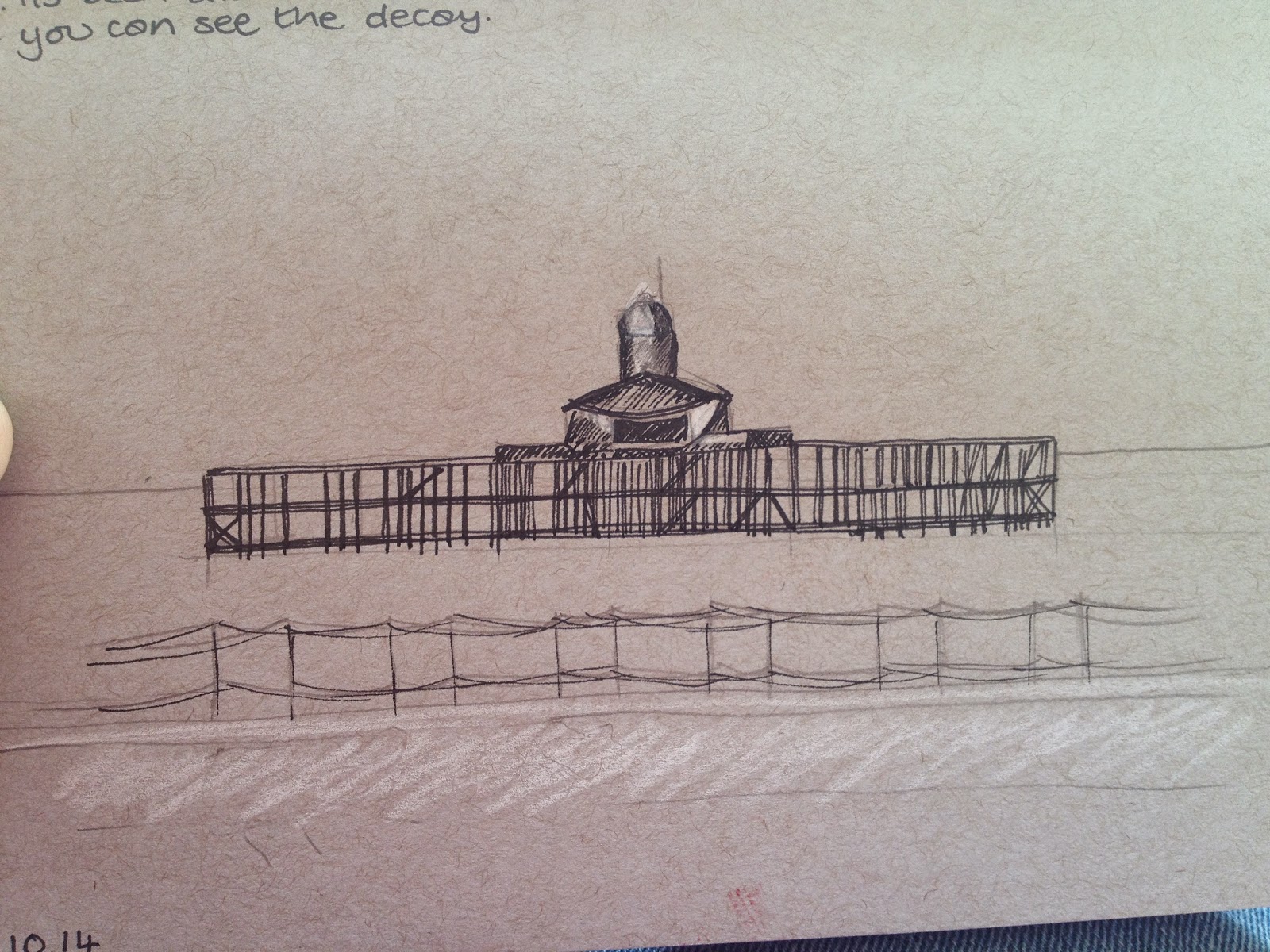
6 – simple lines can be great…
This links with number 7.
Don’t think you have to colour or shade everything. Often I have left stuff
like below. On the other hand I’ve also shaded stuff and not liked it… don’t be
afraid of just having lines.
7 – revisit places.
This view is one that I’ve drawn many
times over the past 20 years. I never get further than the left bit. As soon as
perspective comes into play, I wouldn’t go any further. This Christmas I went
back to the same spot and sat and drew this. Simple lines, perspective, and
complete and I’m very proud I finally did it! Each time you go back and draw something again you can see how you have developed.

8 – trust your eyes, not your head.
The advice is to look
more at the object than your paper. Blind contour drawing and semi blind really
helped. I would follow the shape with my eyes and then move my hand on the
paper without looking at it. Often when the object was complex, or my brain was
trying to tell me something different, I had to just trust my eyes and hand and
it would come out pretty close to what it was. Draw what you see, not what you
think it is. If you are struggling – search for blind contour drawing and
practice it.
9 – its not about the colour… its about the tone
I did a
Craftsy class with Steve Reddy. In it he talks about Grisaille underpainting
technique with diluted inks. I had been struggling with colour so I took a step
back and began to work in monochrome and tonal shades. The ability to use ink
layers to build up the dark areas also helped. The result is below. The
Imperial War Museum of the North, done on a blazing hot day at the end of
August. Steve usually adds colour at the end to his drawings but I decided that
I actually like the monochrome approach and left it as is, particularly as the
building is silver and grey.


10 – You will have your own style….
I don’t know what mine
is; but I have accepted that my interpretation of a view or object is no more
or less valid than someone elses. I used to beat myself up because it ‘wasn’t
as good as….(insert name)’ Now I appreciate my drawings for just being mine. I'm starting to see it with this below, the Avro aircraft at the Museum of Science and Industry. Something two years ago I would never have tried or been highly critical of my skills - now I appreciate the delicate line and the ink washes.


11 – When in doubt – look back at the good drawings, see your
progress.
There will always be times when you think you can’t draw or you’ve
lost the skill somewhere. Particularly if you experience artists block. I found
that the best ways to overcome this was :
- Go back and look at the drawings you have done that you are proud of.
- Remember that if you have artists block before – It’s passed and you’ve produced some ace drawings since.
- Keep drawing, no matter how terrible you think the drawings are.
- Try and draw every day - even I'm struggling to manage that
- Meet up with other sketchers... it inspires you..
12 - Thank those who inspired you, and inspire others
Thank you to Martin Dutton; A long time family friend who saw my artistic potential many, many years ago when I didn't even see it in myself. See his work here...
http://www.martindutton-devonartist.co.uk/

Comments
Post a Comment